
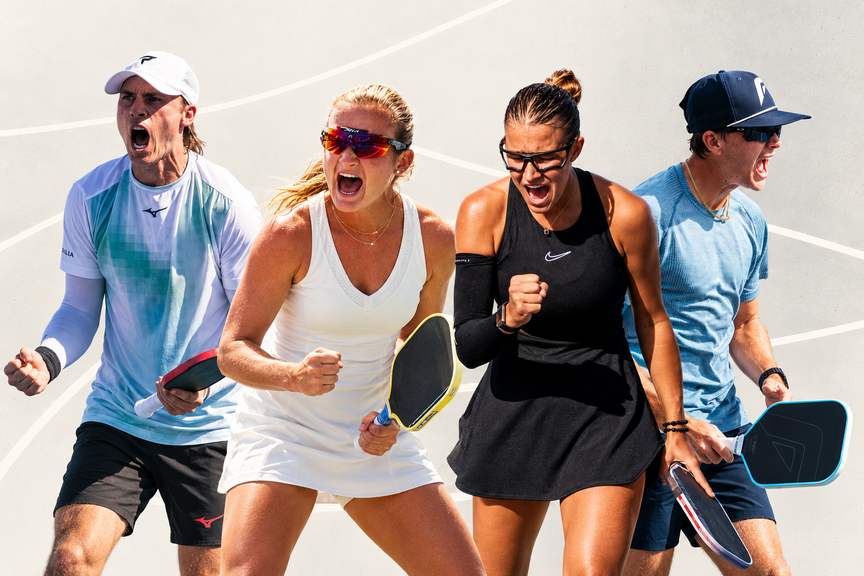
The debate over screaming and taunting has divided professional pickleball. But can the sport distinguish competitive passion from poor sportsmanship without silencing its players?
Professional pickleball has a screaming problem.
Or does it?
Over the past two weeks, one of the most polarizing debates in professional pickleball hasn't involved paddle testing, questionable line calls, or the sport's complicated professional landscape.
It's been about screaming.
More specifically, whether the PPA Tour and Major League Pickleball should introduce a rule penalizing players for excessive celebrations and taunting.
Some believe the sport needs clearer behavioral boundaries. Others argue that emotion, trash talk, and controversy are exactly what professional pickleball needs to grow.
I believe there's a reasonable middle ground, but I'm not convinced another rule is the answer.
The Match That Started It All
The controversy began at the PPA Chicago Cup when Maria Ford defeated former tennis star and current No. 16-ranked women's singles player Genie Bouchard.
Throughout the second and third games, Ford repeatedly screamed following points. Bouchard grew visibly frustrated and ultimately walked off without tapping paddles after the match.
Clips circulated across social media, generating thousands of comments debating whether Ford's celebrations crossed the line.
On October 14, fellow pickleball journalist Jim Kloss published an article titled The Time Has Come for PPA to Adopt an Anti-Taunting Rule.
Kloss proposed giving referees the authority to penalize excessive screaming and intimidating gestures based on factors including frequency, volume, whether the behavior was directed at opponents, and whether it followed an opponent's mistake.
His proposal included warnings followed by escalating penalties.
He specifically mentioned Ford and Kate Fahey as examples of problematic behavior while distinguishing their celebrations from Anna Leigh Waters' occasional vocal encouragement.
That's where I think his argument begins to fall apart.
The Players Push Back
Anna Bright was among the most outspoken critics of the proposal, suggesting that anyone wanting to eliminate screaming should go watch paint dry.

Kate Fahey raised a different concern: Why are women being criticized for screaming while men regularly engage in aggressive trash talk at the kitchen line?
@pickleball_jim Appreciate the cover photo, Jim. But if you’re going to call me out for yelling but not the men who make it a point to trash talk at the net directly to their opponents, that’s “disingenuous”
— Kate Fahey (@katefahey6) October 14, 2026
It's a legitimate issue - why are women who celebrate by screaming being targeted, rather than the men in the sport who hurl insults at each other across the net?
At the same Chicago Cup, Hayden Patriquin and Eric Oncins exchanged heated words during men's doubles, with Patriquin acknowledging that he insulted Oncins. And it wasn't the first time Patriquin's trash talk had generated controversy.
Yet Ford's wordless screaming became the catalyst for a proposed rule change.
If we're going to police behavior, the standards must apply equally to everyone.
Zane Navratil took the argument even further.
In the video above, Navratil argued that athletes should be allowed to scream and even taunt opponents because controversy creates entertainment.
He pointed to the NFL's unpopular taunting restrictions and the UFC's success building personalities through trash talk.
Navratil also acknowledged regretting his own aggressive screaming incident during MLP competition, while recognizing that it generated considerable attention.
I don't agree that entertainment value should excuse every type of behavior. But Navratil makes an important point.
Professional pickleball is still fighting for viewers, sponsorship dollars, and mainstream recognition.
Do we really want to discourage the personalities that make people watch?
Where Do We Draw the Line?
Here's my biggest issue with the proposed rule.
How do you objectively determine when a celebration becomes excessive?
If a player screams after winning a spectacular 40-shot rally, is that acceptable? What about after a routine winner? Or five consecutive points? At what point does celebrating become a punishable offense?
During The PicklePod's October 20 discussion, Nico the Lefty questioned how referees could consistently enforce restrictions based on volume and frequency.
I agree completely.
We already have enough controversies surrounding officiating. The last thing we need is another subjective judgment that could influence the outcome of a championship match.
But I also believe there's a clear difference between celebrating yourself and deliberately intimidating someone else.
Screaming toward your partner or bench after an important point? Absolutely fine.
Walking toward the net and screaming directly in an opponent's face? That's different.
Repeatedly directing personal insults at an opponent? There should be consequences.
The focus should be on behavior intended to intimidate or provoke, not simply how loud or emotional someone becomes.
Pickleball Needs Personalities, Not More Restrictions
Professional pickleball is still developing as a spectator sport.
It needs rivalries. It needs recognizable personalities. And yes, it needs players some fans love to hate.
Think about John McEnroe in tennis. His talent made him great, but his personality made him unforgettable. Fans don't always tune in because they love every athlete.
Sometimes they tune in because they desperately want to see someone lose.
Players such as Christian Alshon, Hayden Patriquin, Kate Fahey, and others bring emotion and personality to professional pickleball.
Not everyone appreciates their celebrations, which is perfectly fine. We shouldn't require professional athletes to be universally liked.
However, there is a distinction between embracing competitive personalities and tolerating behavior that genuinely undermines sportsmanship.
What Can Pickleball Learn From Other Sports?
Professional pickleball isn't the first sport to wrestle with taunting.
The NFL has penalized taunting for decades, but its enforcement history offers a cautionary tale. In 2017, the league relaxed its celebration restrictions, allowing players more freedom to express themselves while keeping penalties for conduct directed at opponents.
In 2021, the NFL renewed its emphasis on taunting, leading to several controversial calls. One of the most notable involved Chicago Bears linebacker Cassius Marsh, whose celebration following a sack resulted in a 15-yard penalty that extended a Pittsburgh Steelers drive. The NFL defended the call, but it became a prime example of how subjective enforcement can influence games.
The NBA takes a somewhat more targeted approach. Its official rules require a technical foul for blatant taunting of an opponent, including certain confrontational gestures and verbal actions. College football also penalizes taunting, while professional tennis uses escalating penalties for abusive and unsportsmanlike behavior.
Here's my takeaway: Other sports have shown that you can protect celebrations while penalizing conduct directed at opponents. But they've also shown how quickly subjective officiating can become the bigger controversy.
Professional pickleball should learn from both lessons.
We don't need to penalize athletes for showing emotion. We need consistently enforced standards for behavior that deliberately intimidates, abuses, or provokes opponents.
That's a much better starting point than asking referees to determine when a player has screamed one too many times.
Not everyone agrees. In fact, Kloss has become even more emphatic in his support for a new rule.
Kloss Doubles Down — But Does His Argument Hold Up?
On October 26, Jim Kloss published a follow-up opinion piece, responding directly to Zane Navratil and others who criticized his proposal.
Kloss argues that every professional sport needs behavioral limits, that the NFL continues to enforce anti-taunting penalties, and that referees can be trained to distinguish acceptable celebrations from unsportsmanlike conduct.
I actually agree with much of that.
But I think his argument misses an important distinction.
Nobody is suggesting professional pickleball should allow fighting, threatening behavior, or unrestricted verbal abuse. Those are fundamentally different from a player screaming after winning a point.
Kloss also argues that players such as Ben Johns and Anna Leigh Waters prove that professional pickleball can be entertaining without taunting.
Of course it can. But nobody is suggesting otherwise.
Great competition and compelling personalities aren't mutually exclusive.
Where I disagree most is his confidence that referees can consistently determine when screaming becomes excessive. Yes, officials make subjective calls in every sport. That doesn't mean we should introduce additional subjective standards unless they're necessary.
Kloss points to the NFL's decades-long enforcement of taunting penalties as evidence that professional pickleball should follow suit. But the existence of a rule doesn't automatically prove that it's effective, consistently enforced, or appropriate for another sport. And the NFL's own history demonstrates just how controversial those judgment calls can become.
Kloss is absolutely right that professional sports need boundaries. But establishing that boundaries are necessary doesn't automatically mean his proposed rule is the right solution.
The burden should be on those proposing new penalties to demonstrate what existing rules cannot address, not simply to establish that some fans find screaming annoying.
Here's my biggest issue with Kloss's proposal: Why should the frequency or volume of a celebration help determine whether it's unsportsmanlike? A player screaming after five consecutive points isn't necessarily behaving worse than someone screaming once. The intent and direction of that behavior should carry far more weight than how often or how loudly it occurs. Otherwise, we're potentially penalizing athletes for being consistently emotional rather than genuinely unsportsmanlike.
My Take: Enforce Sportsmanship, Don't Regulate Emotion
After considering both of Jim Kloss's articles and examining how other professional sports handle taunting, I'm still not convinced pickleball needs a sweeping new rule targeting excessive screaming.
I agree with Kloss that professional sports need behavioral boundaries. Where we disagree is how those boundaries should be defined and enforced.
The UPA should first determine whether its existing rules adequately address deliberate intimidation, threatening behavior, and verbal abuse. If they don't, clarify those provisions.
But don't create a rule that potentially penalizes players simply because they celebrate too loudly or too frequently.
And whatever standards are established must apply equally to men and women, superstars and lesser-known professionals, championship courts and outside courts.
I also agree that professional athletes influence younger players. But being a role model doesn't mean suppressing every emotional reaction. Young players should learn that celebrating success is acceptable while deliberately disrespecting opponents is not.
The real challenge for the UPA isn't figuring out how to make pickleball quieter. It's determining which behaviors genuinely cross the line and which simply make certain players unpopular.
And until that distinction is clearly established, another subjective rule may create more problems than it solves.
Professional pickleball doesn't need fewer personalities. It needs clearer boundaries.


Love Pickleball? Join 100k+ readers for free weekly tips, news & gear deals.
Subscribe to The Dink