
Rate Your Real Pickleball Skill Level with These 3 Simple On-Court Assessments
Plateaus happen because players don't know what to work on. These three assessments solve that problem.
If you've hit a plateau in your pickleball game, you're not alone. Many players find themselves stuck, unsure of their actual skill level or what to work on next.
The good news? You don't need a fancy coach or expensive equipment to figure it out. Jordan Briones from Briones Pickleball Academy has created three simple, measurable assessments that'll show you exactly where you stand and what parts of your game need attention most.
Love pickleball? Then you'll love our free newsletter. We send the latest news, tips, and highlights for free each week.
The Return Assessment: Your Foundation
Your return of serve is everything. It's the first shot you control, and if you can't get it deep, you're already playing from behind.
Here's how to test yourself.
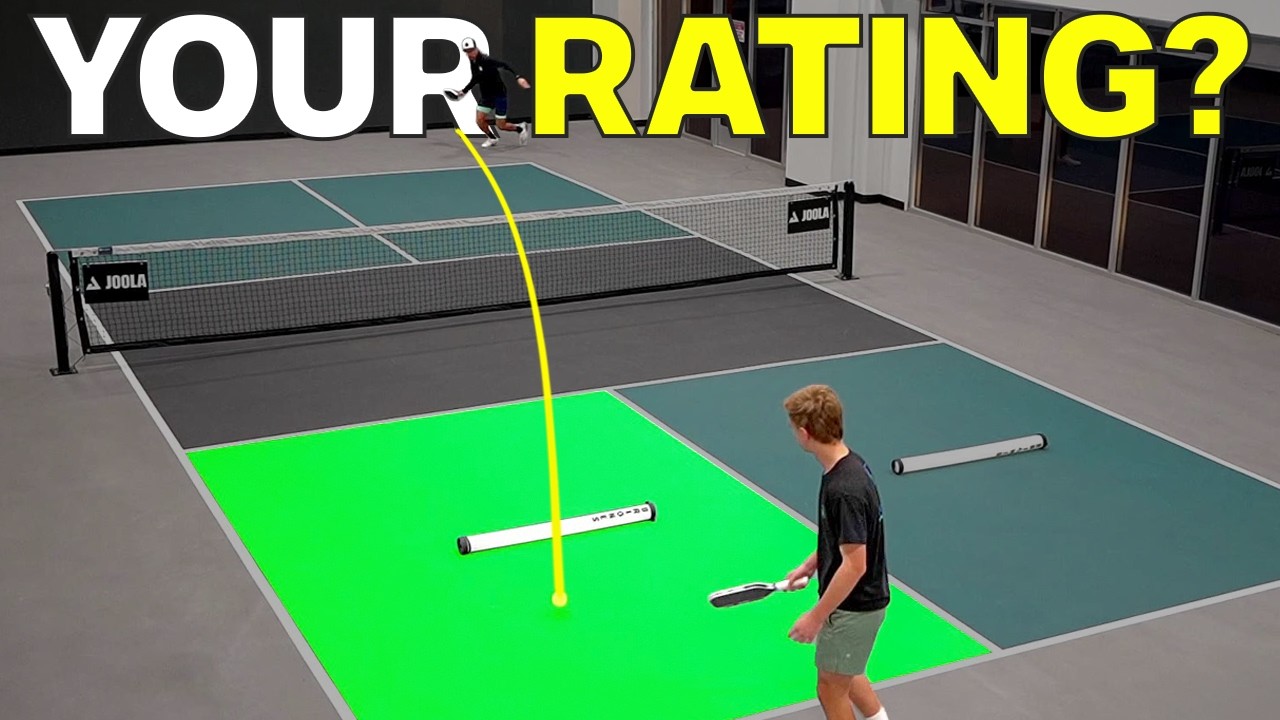
- Set up a marker or cone in the middle of the transition zone on the opposite court. This gives you a visual target for depth.
- You'll hit 10 returns crosscourt from the even side, 10 from the odd side, and 10 straight down the line. That's 30 total returns.
The catch? Your returns have to land past that marker and on the correct side of the court. Short returns don't count. Wide returns don't count.
You're measuring accuracy and depth together, which is exactly what matters in a real match.
Once you've finished all three sets, add up your successful returns and divide by 30. That's your return percentage. Briones scored 76% across his three attempts, which he noted is solid but improvable.
Your number tells you whether your return game is a strength or a weakness that needs work.
The Transition Assessment: Getting to the Net
Pickleball is won at the net, not from the baseline. The transition assessment measures how often you actually make it there.
You'll need a partner at your skill level.
- They start at the non-volley zone and feed you a relatively deep ball
- From there, you choose either a drive or a drop
- Your goal isn't to win the point in one shot
- Your goal is to reach the non-volley zone line and establish your feet there, even if it takes multiple shots
Again, you'll test three directions:
Crosscourt even-to-even, odd-to-odd, and straight down the line. Ten attempts each, 30 total. Count how many times you successfully make it to the net.
Briones scored 83% on this assessment, which he called a solid baseline.
The beauty of this test is that it doesn't penalize you for taking extra shots. It rewards you for the actual goal: getting to the net where you can control the rally.
 The Dink Media Team
The Dink Assessment: Consistency Under Pressure
Dinking is the heartbeat of modern pickleball. This assessment measures how many dinks you can hit in a row while keeping your opponent below net level.
- Start on the even side and dink with a partner
- The key rule: you're only counting the dinks you hit, not the ones your opponent hits
- Every time you touch the ball, that's one dink
- The rally ends when someone misses or when your opponent takes the ball above net level
The goal isn't a specific number. The goal is consistency and control.
You want to force your opponent to contact the ball low, which limits their attacking options. Briones hit 15-plus dinks in his demonstration, showing that when you're hitting quality dinks, your opponent stays pinned down.
Test yourself on all three sides: even, odd, and down the line. Down the line is trickier because you have less court to work with, so your swing speed and control need to be dialed in.
Heads up: hundreds of thousands of pickleballers read our free newsletter. Subscribe here for cutting edge strategy, insider news, pro analysis, the latest product innovations and more.
What These Numbers Actually Mean
Once you've completed all three assessments, you've got a real snapshot of your game. You know your return percentage, your transition success rate, and your dinking consistency.
Here's what matters: these aren't one-time tests.
- You can repeat them multiple times to track improvement
- You can test against different partners to see how your game holds up under different pressure
- You can identify which assessment is your weakest link and focus your practice there
The assessments also reveal your playing style. If you're driving your way to the net instead of dropping, that's useful information. If your dinking is solid but your returns are weak, you know where to spend your court time.
 The Dink Media Team
Plateaus happen because players don't know what to work on. These three assessments solve that problem. They're simple enough to do on any court with a partner, and they give you concrete numbers to chase.

Love Pickleball? Join 100k+ readers for free weekly tips, news & gear deals.
Subscribe to The DinkGet 15% off pickleball gear at Midwest Racquet Sports