
Make Practice Skills Stick: The 70% Rule for Match-Proof Pickleball
Smooth, repeatable drills can make you look great in the moment, but they often create fragile skills that do not hold up when the ball, timing, opponent, and stakes change
Ever feel like you own a shot in drilling, then it completely disappears in a match? In a recent video, Pickleball Prescription breaks down why that happens and how to redesign practice so your skills transfer under pressure, variability, and real points.
Love pickleball? Then you'll love our free newsletter. We send the latest news, tips, and highlights for free each week.
Why your best shots vanish when it matters
The big mistake, according to motor learning research, is confusing practice performance with learning.
Smooth, repeatable drills can make you look great in the moment, but they often create fragile skills that do not hold up when the ball, timing, opponent, and stakes change.
Performance vs learning (and why it changes how you drill)
Performance is how well you execute right now, usually in stable conditions (same feed, same timing, same response). Learning is a more permanent change that shows up later and transfers to match play.
That gap explains the classic experience: your drill reps climb quickly, confidence rises, then match results do not follow.
Desirable difficulty and the challenge point idea
The video leans on the concept of desirable difficulty (Bjork and Bjork): practice should be hard enough to produce informative mistakes, but not so hard that it becomes chaos.
This is where the challenge point framework comes in: as a task gets harder, practice performance tends to drop, but learning can increase up to an optimal middle zone. Too easy and you are not adapting. Too hard and you cannot calibrate what to change.
 The Dink Media Team
The 3 difficulty dials you can control in practice
Pickleball Prescription describes three practical ways to tune practice difficulty so it matches what you actually face in games.
1. Practice structure (blocked to random)
Practice structure is how you organize reps along a spectrum:
- Blocked: one shot over and over (predictable)
- Serial: a repeating sequence (ABC, ABC, ABC)
- Interleaved: different shots mixed based on the incoming ball (requires decision-making)
- Random: unpredictable situations and skills mixed (most game-like, but can be too hard early)
A memorable rule from the video: blocked to start, interleaved to stick. Use blocked reps to learn or clean up a movement, then move to interleaving to build retention and transfer.
Heads up: hundreds of thousands of pickleballers read our free newsletter. Subscribe here for cutting edge strategy, insider news, pro analysis, the latest product innovations and more.
2. Variability (change the conditions)
Variability is not just mixing the order. It is changing the conditions: spin, speed, depth, location, and even environment (wind, sun). If your lob fails in wind, practice lobs on a windy day. If your drop fails versus slice, train drops versus slice.
 The Dink Media Team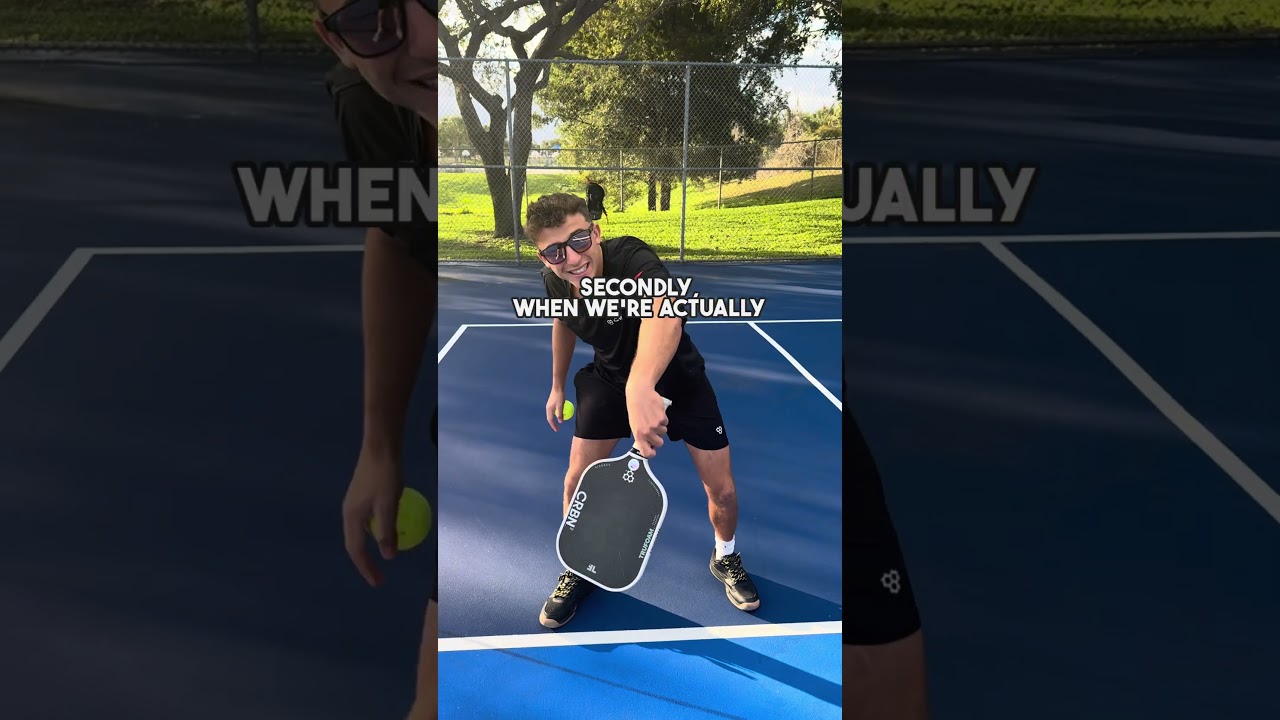
3. Task constraints (change the rules)
Constraints are simple rule changes that nudge better solutions without over-coaching mechanics. Examples from the video include:
- Give a consequence for a repeated mistake (for example, third shot into the net equals a point for the other side)
- Create a visual requirement (hang a string 1 to 2 feet above the net and require your drop to clear it)
- Limit when you are allowed to attack (speed-ups only from balls above a certain height)
 The Dink Media Team
The 70% rule: a quick test for the right difficulty
To find the optimal challenge point, the video suggests aiming for roughly a 70% success rate in drilling (about 30% errors). If you are making nearly everything, it is probably too easy to drive adaptation. If you are missing half or more, you may need to scale difficulty down so the errors become useful instead of random.
5 match breakdowns and the drill adjustments to fix them
Instead of guessing what to practice, use match outcomes as your diagnostic. Here are the video’s five common breakdowns and the practice tweak that matches each one.
1. Too many unforced errors
If you are losing points by spraying routine balls, your skill is not stable enough. Adjust by reducing difficulty temporarily:
- Move from random practice down to interleaved, serial, or even blocked for 5 to 10 minutes.
- Add constraints that increase margin (bigger targets, higher net clearance) until you return to the 70% zone.
2. Speeding up too soon
If you attack low balls out of impatience, use constraints to retrain decision-making:
- Dink three balls before you are allowed to speed up.
- Only speed up balls that are thigh-high or higher.
3. Stuck in transition (cannot get to the kitchen)
If your team never establishes the non-volley line, the fix is to train the sequence, not just one shot:
- Serve, partner returns, you hit the third, then decide: crash if it is good, or hold and reset if it is short or high.
- This is interleaving: you are practicing serve, third, and fifth together under decision pressure.
4. Attackable dinks
If your dinks sit up and get punished, you likely do not need more casual dink reps. You need constraints on your dinking:
- Use the string-above-the-net idea and require dinks to stay under it.
- Create a “no attack” landing zone and keep the rally going only when the ball lands in it.
- Add a consequence: any dink above the string is automatically attackable for the opponent.
5. Short returns
If returns land short and you get crushed on the way in, pair constraints with variability:
- Constraint: place tape in the transition zone and require returns to land past it.
- Variability: have a partner mix serves (location, speed, spin) so you learn depth under changing looks.
The takeaway for pickleball players
If you want match-proof skills, build practice that includes decision-making, variable inputs, and targeted constraints. Combine that with the 70% rule and you have a simple way to dial difficulty up or down without guessing.
Love Pickleball? Join 100k+ readers for free weekly tips, news & gear deals.
Subscribe to The DinkGet 15% off pickleball gear at Midwest Racquet Sports