How to Play Pickleball: The Complete Rules Breakdown for Doubles
The beauty of pickleball is that once you understand these fundamentals, the game opens up. You start thinking about strategy, positioning, and shot selection. Pretty soon, you're hooked.
Love pickleball? Then you'll love our free newsletter. We send the latest news, tips, and highlights for free each week.
What Makes Pickleball Rules for Doubles Unique (And Why That Matters)
Before we get into the nitty-gritty of rules, let's establish what we're actually talking about here.
Pickleball is a paddle sport that borrows from tennis, table tennis, and badminton.
The paddle looks more like an oversized ping-pong paddle than a tennis racket, and the ball itself resembles a wiffle ball.
The paddle looks more like an oversized ping-pong paddle than a tennis racket, and the ball itself resembles a wiffle ball.
Here's the kicker: you can fit four pickleball courts on a single tennis court. A pickleball court measures 44 feet by 20 feet and divides into three zones: the right box, the left box, and the kitchen (also called the non-volley zone).
The game plays to 11 points, and you've got to win by two. Simple enough, right? The complexity comes in the rules that govern how you actually play.
The Three Fundamental Pickleball Rules for Doubles That Run Everything
1. Pickleball Rules for Doubles: The Serve
Let's start with the serve, because it's where every rally begins. Both feet must stay behind the baseline while you're serving. One foot can hover over the line, but at least one foot needs to stay grounded.
You can't jump in the air and serve like you might in tennis. The serve has to be underhand, with the paddle face making contact below your wrist and below your waist.
There's a variation called the drop serve that loosens some of these restrictions. With a drop serve, you simply drop the ball and let it bounce before hitting it.
You can't throw it down to make it bounce higher, though. That's cheating, basically.
The ball must travel diagonally across the net and land beyond the kitchen line. If it lands on the kitchen line itself, it's a fault. Hit any other line beyond the kitchen? You're good.
 The Dink Media Team
2. The Two Bounce Rule
Here's where pickleball rules for doubles separate themselves from tennis. In tennis, you've got the serve-and-volley strategy where a strong server rushes the net immediately. Pickleball doesn't allow that.
After the serve, each team must let the ball bounce once on their side before they can hit it out of the air (or volley it). This rule applies to both the serving team and the receiving team.
In pickleball, being at the net is where you're most dangerous, so once that bounce requirement is satisfied, players move forward aggressively.
If you're a tennis player making the switch, the common mistakes tennis players make when transitioning to pickleball are worth knowing before you step on a doubles court.
Heads up: hundreds of thousands of pickleballers read our free newsletter. Subscribe here for cutting-edge strategy, insider news, pro analysis, the latest product innovations and more.
3. The Kitchen: The Most Confusing Pickleball Rules for Doubles
The kitchen, or non-volley zone, is the area extending 7 feet from the net on each side of the court. This is where things get tricky for beginners.
You can't hit the ball out of the air when you're standing in the kitchen.
But there are three specific rules that govern this:
Kitchen Rule #1: If you hit the ball out of the air, your feet can't touch the kitchen line or be inside the kitchen. Your feet can hover above it, but they can't make contact with the line or cross into the zone.
Kitchen Rule #2: If you hit a ball out of the air and your momentum carries you into the kitchen, even after the point is technically over, that's a fault. Your partner can yell "help" and pull you out before you fall in, and that's perfectly legal. Otherwise, you need to stay out or accept the consequence.
Kitchen Rule #3: If the ball bounces in the kitchen, you can step in there all day and retrieve it. The official rule states: "A player may enter the non-volley zone before or after returning any ball that bounces."
You don't have to wait for the ball to bounce before stepping in either. You can anticipate the bounce and get in there early to hit the ball.
 The Dink Media Team
Five Ways to Win a Rally
Once you understand these pickleball rules for doubles, winning becomes clearer.
You win a rally if your opponent:
- Hits the ball out of bounds
- Hits the ball into the net
- Lets the ball bounce twice on their side
- Commits a kitchen violation
- Gets hit by the ball
How Pickleball Rules for Doubles Define Scoring
Here's the thing about pickleball scoring that confuses most beginners: you can only score points when your team is serving. This is crucial.
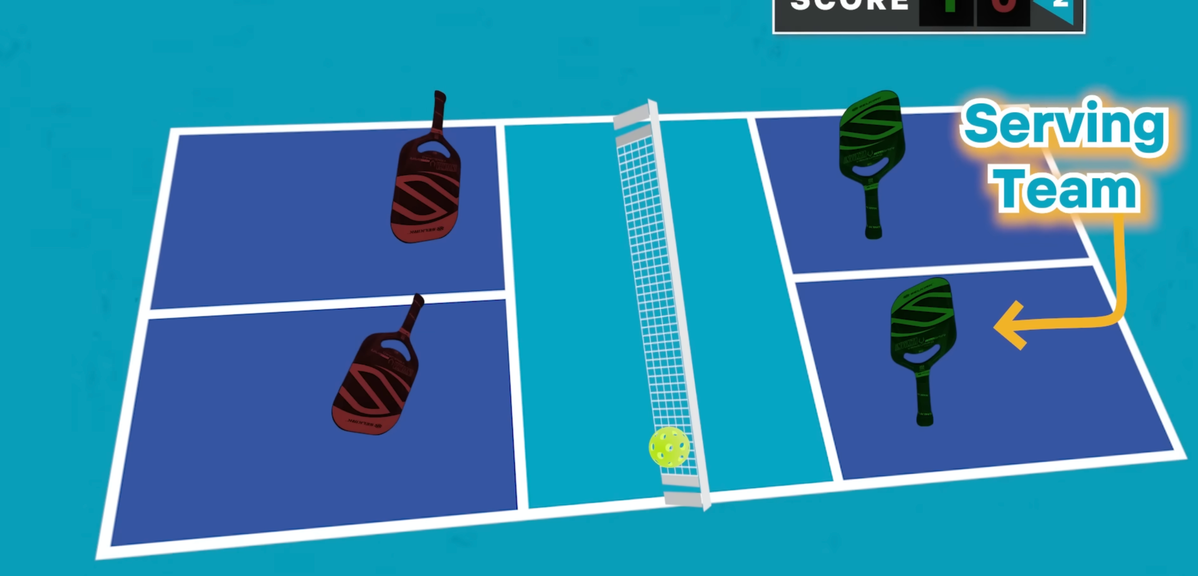
The first person on your team serves, and if they win the point, they switch sides to the other box and continue serving. If they lose the point, the serve goes to their partner.
Both players on a team get to serve and score points during what's called a "possession." A possession is any time you or your partner are serving and have a chance to win points.
When the second server loses, the possession ends and the serve switches to the other team. This is called a "side out."
The score itself has three numbers.
- The first is your team's points
- The second is your opponent's points
- The third number is either a one or a two, representing the serving order
Whoever is on the right box when a side out occurs becomes the "one" (first server) for that possession. When the one loses, the serve goes to the two. When the two loses, it's a side out.
Hot tip: the same player might be the one at one point in the game and the two at another point. It's not fixed. It's whoever ended the previous possession on the right box.
 The Dink Media Team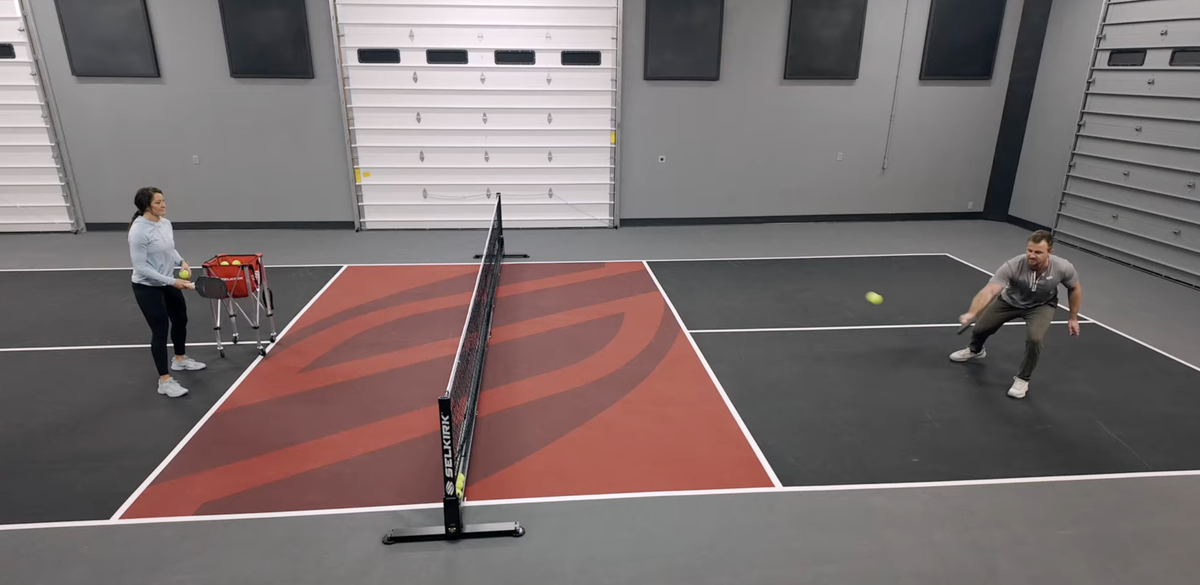
Watching It All Come Together
Koszuta's video includes actual gameplay footage showing Kyle and his teammate Wendy playing against Tyler and JT. The game starts at 0-0-2, meaning the serving team only gets one chance to serve and score at the beginning (a rule designed to minimize the advantage of serving first).
As the game progresses, you see the score change from 1-0-2 to 1-1-1 to 2-1-2, with players switching sides and the serve moving between teammates and teams.
Watching real gameplay makes the pickleball scoring system click in a way that pure explanation sometimes can't. You see the rhythm of the game, the positioning, and how the rules actually play out when people are moving around the court.
Why This Matters
Pickleball's growth has been nothing short of remarkable ESPN, and millions of people are picking up paddles for the first time. Many of them are showing up to courts without a clear understanding of the rules. That's not a judgment; it's just reality.
The sport's accessibility is part of its appeal, but that accessibility means a lot of new players need guidance on how to play pickleball the right way.
Koszuta's video addresses this head-on. By breaking down the pickleball rules for doubles including the serve, the two-bounce rule, and the kitchen rules in a clear, methodical way, he's helping people actually enjoy the game instead of spending 30 to 40 minutes arguing about what's legal and what isn't.
Frequently Asked Questions
What Are the Basic Pickleball Rules for Doubles?
In pickleball rules for doubles, every rally starts with an underhand diagonal serve, and both teams must let the ball bounce once before volleying. The game plays to 11 points and only the serving team can score, which makes possession a key strategic concept.
What Is the Kitchen Rule in Pickleball?
The kitchen rule means you cannot volley the ball while standing in the non-volley zone, which extends 7 feet from the net on both sides of the court. Even if your momentum carries you into the kitchen after a volley, it counts as a fault.
How Does Scoring Work in Doubles Pickleball?
Scoring in doubles pickleball uses a three-number system: your team's score, your opponent's score, and the server number (1 or 2). Only the serving team can earn points, and possession switches to the other team after both servers lose their serve.
What Is the Two Bounce Rule in Pickleball?
The two-bounce rule requires the receiving team to let the serve bounce before returning it, and the serving team must also let that return bounce before volleying. This rule prevents the serve-and-volley strategy that dominates tennis and ensures both teams start each point from the baseline.
Can You Step Into the Kitchen in Pickleball?
Yes, you can step into the kitchen at any time as long as you are not hitting the ball out of the air. If the ball bounces in the kitchen, you are free to step in and retrieve it without any penalty. The only restriction is volleying from inside the kitchen zone.

Love Pickleball? Join 100k+ readers for free weekly tips, news & gear deals.
Subscribe to The DinkGet 15% off pickleball gear at Midwest Racquet Sports