

In a reader poll we published in The Dink Newsletter last week (click here to subscribe), we asked our readers, "How often do you purchase a new paddle?"
The results were a bit different than we had anticipated:
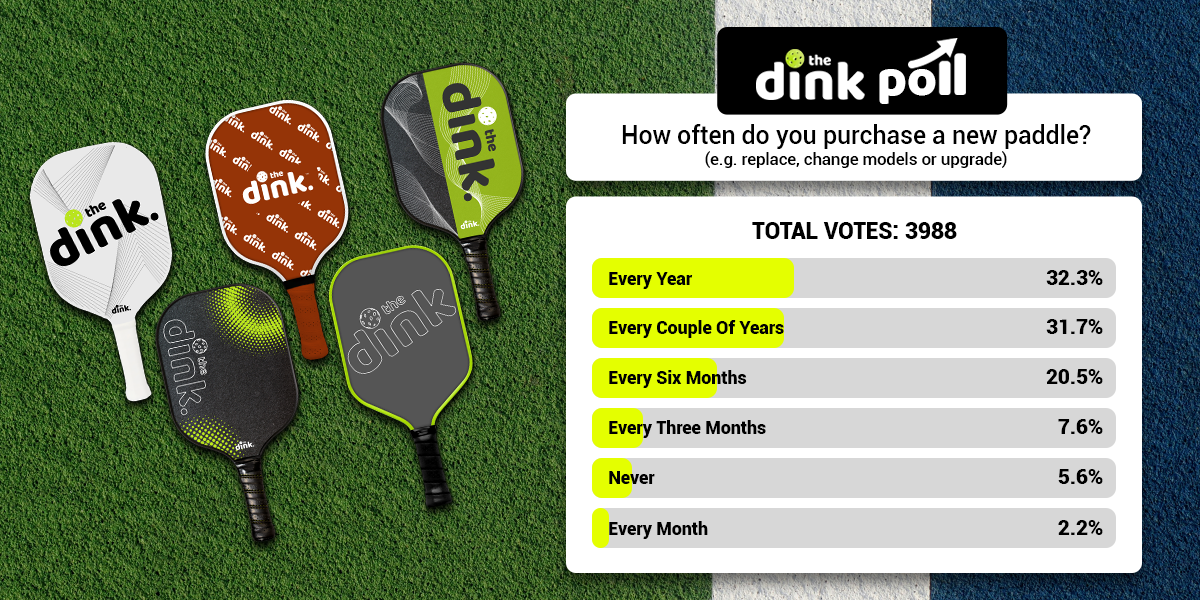
- Every Year - 32.3%
- Every couple of years - 31.7%
- Every six months - 20.5%
- Every three months - 7.6%
- Never - 5.6%
- Every month - 2.2%
We were a bit surprised at how infrequently so many pickleballers change up their pickleball paddles. Personally, I try to have at least six paddles in my bag at all times, but maybe I have a problem.
 Alina Leontarakis
With 64 percent of the nearly 4,000 of you telling us you wait a year or longer before changing paddles, we wondered: "How often should we change our pickleball paddles?"
That's what we address here. But first, let's talk about paddle quality.
How important is a quality pickleball paddle?
When pickleball first started, they used homemade wooden paddles. In fact, you can still buy wooden paddles from Amazon today. It's not recommended, but you could.
Some people will argue that the paddle you use doesn't matter at all — "a good pickleballer never blames his tools," so to speak. Marketing for paddle companies would say the paddle makes all the difference. Of course, the real answer is somewhere in the middle.
Yes, a really good pickleball player can play with anything and get great results. But, if you put the right paddle in their hands, it can make them even better.
Today's paddle technology is like no other time in pickleball history. Paddles can help you shape your shots, pop the ball up less, and add a few extra hundred RPMs to your drives, making them dip down instead of rise. If you're serious about improving, it's worth reading our pickleball paddle buying guide before you commit to a new stick.
So, while we're not going to tell anyone they'll become a pro if they spend hundreds of dollars on a pickleball paddle, we will say that you don't see Ben Johns out there playing with a z5.
Do pickleball paddles wear out?
The short answer is, yes.
Anything that gets used, especially as much as we use our paddles, will wear out. Even though today's pickleball paddles are made from materials like carbon, plastic, fiberglass, and kevlar (instead of plywood), everything has a shelf life. According to CBS Sports, pickleball is now one of the fastest-growing sports in the country — and all that extra court time accelerates wear on your equipment.
The problem is that most of the time it's difficult to tell whether or not your paddle needs to be replaced. Those tiny grooves that help you put spin on the ball can only be seen under a microscope.
So, unless you have a lab at home, how can you tell when it's time to get a replacement? Look for the signs.
Signs you need a new pickleball paddle
There are so many paddles available today. Which means, mileage may vary and the signs yours need replacing may vary too. However, there are some common issues you can look for when considering a new paddle.
This includes:
- Loss of pop or power in your shots
- Visible dents, cracks, or chips on the face or around the edges
- Your handle is weakened where it joins with the face
- An obvious warp across your paddle face
- You have zero spin on shots that you typically have spin on
- Something is rattling inside
- The core is crushed
Some of these signs are obvious (cracking, warps, rattling), while others may be a bit more deceptive (game play is off or the core is crushed). Sometimes players can just know something isn't right.
For instance, if you have a favorite shot that you've always hit well and suddenly you can't, then it might be your paddle. Understanding how paddle technology affects your shot mechanics can help you recognize when the problem is the equipment, not the technique.
A note on core crush. If the core of your paddle is crushed, you may not be able to tell by looking at it. To test for core crush, place the palms of both hands on the face of your paddle (like a sandwich) and push your hands together. If it makes a squishy sound, then you may have core crush issues.
You may even hear it when you hit a ball in a specific spot. It'll almost sound like a gunshot. You'll want to contact your paddle manufacturer about this and ask for a replacement.
How to make your paddle last longer
There are several ways you can make your paddle last longer. First, play less pickleball. Just kidding. No one is doing that.
Some actual ways to keep your paddle in game shape include:
- After play, wipe your paddle clean and use a paddle cover.
- Keep your paddle in a cool, dry environment – yes, the same way you'd care for a pet.
- Get a pickleball paddle eraser or some form of cleaning solution – make sure both are safe for your particular paddle before using.
- Change your grip or overgrip regularly to keep it from slipping out of your hands during play.
- Don't abuse your paddle when you miss an overhead for the third time in a row.
Alina Leontarakis
How often should you change your paddle
While this is going to be a different answer for everyone, the main point worth making is that you should change your paddle:
a) when you want to – after all, it's your money, or ...
b) when your paddle is causing you to play worse
Pickleball paddles can be expensive and there's no guarantee that the latest and greatest will fit with your game. If you are considering getting a new paddle, consider demoing one — some pickleball clubs have demo programs and there are websites that offer demos.
You could also ask a friend to borrow theirs for a game or two. Just don't chuck it over the mountains when you lose.
Pro tip: Before you invest in something new, check what the pros are actually gaming — tracking all the new pro paddle deals in 2026 can give you a strong sense of where paddle technology is headed. And if you're still not sure where to start, Sports Illustrated has covered how pickleball's explosive growth is driving major innovation in paddle design — a useful read for any serious player evaluating their next purchase.
If you're newer to the game and still figuring out what paddle is right for you, our beginner's guide to pickleball fundamentals can help frame the bigger picture. And if you're already playing regularly and wondering how paddle performance ties into overall game improvement, understanding the pickleball plateau is worth a read — sometimes it's the paddle, but often it's something else entirely.


Frequently Asked Questions
How long does a pickleball paddle typically last?
Most recreational players can expect their pickleball paddle to last between one and three years, depending on how often they play and how well they care for it. Players who hit the court multiple times a week will naturally see more wear than casual weekend players. If you notice a drop in performance before that window, don't wait — a degraded paddle can actively hurt your game.
What is core crush and how do I know if my paddle has it?
Core crush happens when the internal honeycomb structure of your paddle is compressed or damaged, usually from repeated hard hits or an accidental strike against a fence, court surface, or another paddle. To test for it, press both palms firmly against opposite faces of the paddle and squeeze gently — a squishy or hollow sound is a red flag. If you suspect core crush, contact your paddle manufacturer, as many will replace a defective paddle under warranty.
Can a worn-out pickleball paddle cause injuries?
Yes — a paddle that's lost its proper weight distribution, balance, or grip can increase your risk of elbow and shoulder strain. When a paddle doesn't perform as expected, players often compensate with improper mechanics, which puts extra stress on the arm and wrist over time. If you're dealing with nagging soreness and your paddle is old, replacing it is a smart first step.
Is it worth buying an expensive pickleball paddle?
It depends on your skill level and how seriously you play. A higher-end paddle won't automatically make you better, but the right paddle can complement your playing style — whether you favor spin, power, or control. If you're playing several times a week and genuinely trying to improve, investing in quality equipment makes sense. Just make sure you demo before you buy, or at least read thorough reviews before committing.
How often should I replace my paddle grip or overgrip?
Your overgrip should be replaced every few weeks if you play regularly — more often in hot weather when sweat accelerates breakdown. A slick or worn grip is not just uncomfortable; it can cause you to grip tighter than necessary, leading to arm fatigue and inconsistent shots. Replacing it is one of the cheapest and most impactful things you can do to maintain your paddle's performance feel.
|

Love Pickleball? Join 100k+ readers for free weekly tips, news & gear deals.
Subscribe to The Dink


![Buy & Sell Used Pickleball Paddles The Safe Way [Guide]](https://storage.ghost.io/c/45/ce/45ce2f4d-9511-4400-98d3-c405b89e366a/content/images/size/w378h212/2025/01/THE-PICKLEBALL-SWAP-2--1-.png)
![Buy & Sell Used Pickleball Paddles The Safe Way [Guide]](https://storage.ghost.io/c/45/ce/45ce2f4d-9511-4400-98d3-c405b89e366a/content/images/size/w768h432/2025/01/THE-PICKLEBALL-SWAP-2--1-.png)