
While it may look like pro pickleball matches are just one thousand dinks back and forth, there's another part to the game that it's easy to miss. It's the game within the game.
And there's no better place to watch this part of pickleball unfold then when all four players are up at the kitchen line.
These five tips can be seen during every pro pickleball event, but only if you know what to look for. If you want to keep improving, check out 3 Technical Tips for Winning Kitchen Line Hands Battles in Pickleball for even more advanced strategies.
Kitchen Tip 1: Lean in to shrink the kitchen
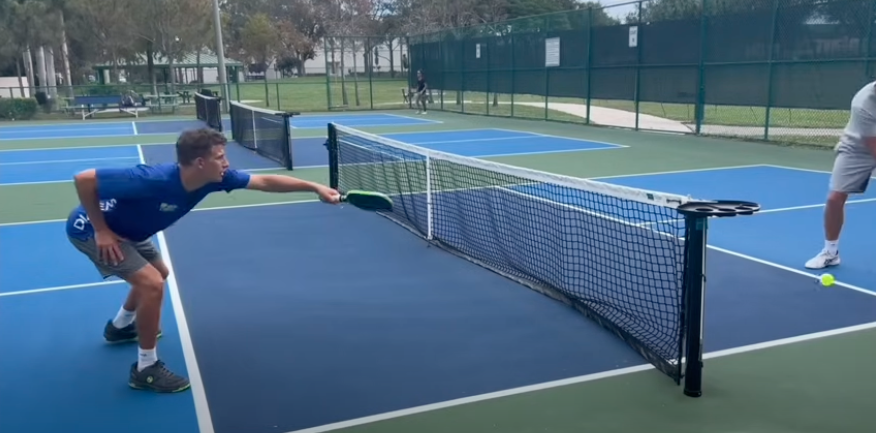
One huge technique advanced-level players use that lower-level players don't is they lean in over the kitchen to take space away from their opponent.
You can also watch the video this image was taken from here:


When you lean in, instead of giving your opponent seven feet of space to work with, you shrink the kitchen, giving them about two to three feet. This forces opponents to be more precise when they try to hit their dinks into your kitchen.
Because you're ready to pounce, when a ball floats up (even a little), a simple wrist flick attack can win you the point. If your opponent does hit a good dink, pull your paddle back and dink it again.
Then get out there and lean in to try again.
The key to this technique is that you are anticipating the next ball might be attackable. Less-skilled players often just stand at the kitchen waiting for their opponent to make their next move before deciding what to do.
This causes them to react instead of anticipate and often leads to overhits, bad swings, and just a general passive (losing) mentality.
By sticking your paddle out and your butt back, you can be in a prime position to strike with a short, compact swing that can get the job done.
Kitchen Tip 2: Think out of the air first
Besides taking space away from your opponent, using better technique will also take their time away. When all players are at the kitchen line, each player only has a second or less to react to the next shot.
If you can take some of that time away, you can cause your opponent to make a bad choice or hit a worse shot.
As you lean over the kitchen, look for balls that you can take out of the air. These might not be attackable balls, but instead, they are slight floaters that you can easily place into an open spot or toward your opponent's weak spot.
Most players let too many of these balls bounce, allowing their opponent to regain their balance and be in a better position for the next shot.
When you take a ball out of the air like this, you aren't necessarily looking to win the rally right there. You're hoping to set up the next shot for an opportunity to hit a winner. Pro players have mastered this concept — read more about it in Master Dink Placement: The Secret to Controlling the Kitchen Line.
Kitchen Tip 3: Create space for a better counter
The third tip continues our talk about anticipating and putting your body in a better position to take your next shot.
What do you do when someone is about to speed the ball up against you? If you're like most of us, you tense up and throw your paddle out after they hit the ball.
That's not what pros do.
 Jason Flamm
Pros anticipate the attack and set their feet and body in a way that allows them to properly defend it — or even attack it. Collin Johns is a master at this.
In this clip, we see CJ perform his backhand fade over and over again. To the naked eye, it looks like he's simply responding to his opponent's attack. But if you could slow it down and look more closely, you can see that Collin is setting up as soon as he realizes an attack is coming.
We can do this too.
If we believe our opponent will speed up the ball, we can create extra space by sliding our body to one side and keeping our paddle out in front of us. Once the speedup happens, all you have to do is guide your paddle to the speedup's location and punch the ball with your paddle.
This works with your forehand or your backhand. According to CBS Sports, pickleball's explosive growth has drawn serious athletes who have brought exactly these kinds of counterattack strategies from other racket sports into the game.
Kitchen Tip 4: Get pulled out wide, reset middle
When we get pulled out wide with a dink, something happens in our brains. We panic. In that panic state, we do silly stuff, like flicking our wrists for some weird attack or trying an ill-advised speed-up.
What we should do is reset the ball to the middle to continue the point.
We want to go back to the middle because it's the safest place on the court to hit a soft dink. Even if you hit a dead dink, you're giving yourself time to recover.
After the reset, you should return your body to a better position and get ready in case the next ball hit by your opponent is attackable. This ties directly into understanding advanced pickleball strategy: the art of controlled aggression, where patience sets up the winning shot.
In this clip, pro James Ignatowich explains why resetting in the middle is so important.
Kitchen Tip 5: Aim Small, Miss Small
"Aim small, miss small" is a common saying in marksmanship. It means that if you aim at a target, you may miss it entirely, but if you focus and aim at the bullseye, you may miss it but still hit the target.
Lower-level players have a saying, too: "I was just trying to get the ball in." While this might serve you well when you first start, you need to start aiming at much smaller targets if you want to develop into a stronger player.
At the kitchen line, your goal shouldn't be just to get the ball over the net or into your opponent's kitchen. It should be to place the ball on the inside of your opponent's left foot — which is typically a safe spot to aim because it's harder for right-handed opponents to generate offense from that spot.
Or, if you're executing a speedup, instead of aiming for an open area or "at your opponent," aim for their belly button, underarm, or dominant side hip.
Even if you don't hit that spot precisely, you'll come much closer than you might think. The benefit is that once you find where your opponent is weakest, you can repeatedly aim for that spot.
For a deeper breakdown of this targeting strategy in action, Sports Illustrated's coverage of elite pickleball highlights how the sport's top pros win at the kitchen line with precision, not power.
Those are your five tips for leveling up your kitchen play. For more techniques that work specifically at the net, the 5 Defensive Dink Styles You Need to Dominate the Kitchen Line is a natural next read.
Now, go out there, practice them a bunch, and begin your pro career. Or just play better pickleball.
Frequently Asked Questions
What does 'playing the kitchen line' mean in pickleball?
The kitchen line — also called the non-volley zone line — is the area at the front of the court, seven feet from the net. Playing the kitchen line means positioning yourself as close to that line as legally possible to volley balls, shorten your opponent's reaction time, and control the pace of dinking exchanges. It's the most strategically important position in doubles pickleball and where most points are ultimately decided.
Why do pro pickleball players lean over the kitchen?
Pros lean over the kitchen to shrink the effective court space their opponents can aim at. When you're standing upright two or three feet back from the kitchen line, you give your opponent a wider target. Leaning in compresses that window to just a couple of feet and puts you in an athletic position to attack any ball that floats even slightly. It's about being proactive rather than waiting to react.
When should I take the ball out of the air at the kitchen line instead of letting it bounce?
Take the ball out of the air any time it's not going to dip below the net after the bounce. Slight floaters — balls that aren't necessarily attackable but are sitting up — should be volleyed rather than allowed to drop. Taking these balls early removes your opponent's recovery time and keeps them off balance. If the ball is clearly dropping into a difficult low position, let it bounce and reset.
How do I stop panicking when pulled out wide during a dink rally?
Train yourself to have one automatic response: reset to the middle. When your body gets pulled out wide, the temptation is to try something flashy. Resist it. A soft, controlled dink back toward the center of the court buys you time to recover your court position. Once you're reset and balanced again, you can re-engage the rally from a position of strength rather than desperation.
What does 'aim small, miss small' mean for pickleball?
"Aim small, miss small" is a precision mindset borrowed from marksmanship. In pickleball terms, it means picking a specific spot on the court — like the inside of your opponent's left foot or their hip — rather than aiming vaguely "into the kitchen." When you aim at a precise target, your misses are smaller misses. Over time this habit dramatically improves your placement accuracy and exposes your opponent's weaknesses more systematically.

Love Pickleball? Join 100k+ readers for free weekly tips, news & gear deals.
Subscribe to The DinkGet 15% off pickleball gear at Midwest Racquet Sports